
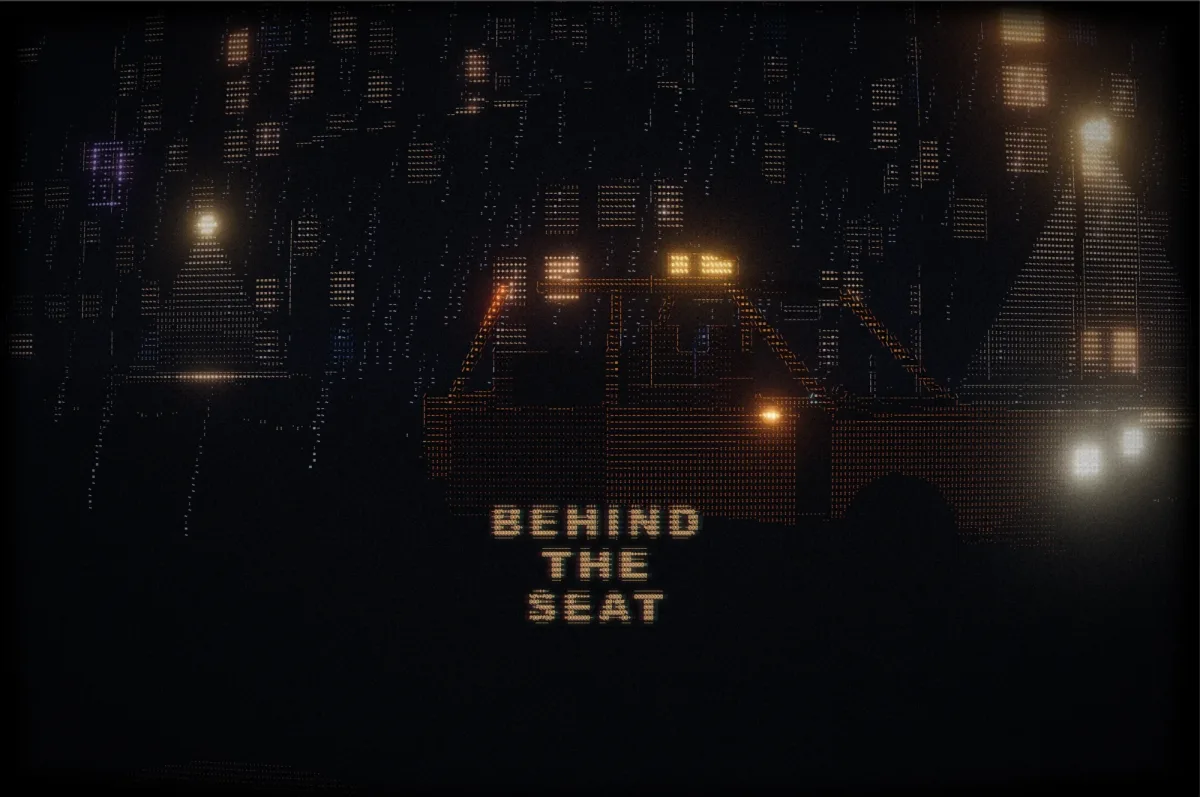
A taxi drives through purgatory at night. Every passenger is a soul who has forgotten who they were. The driver only asks one question: When?
  :  .  :    .    :  .   :   .  :   .  :
 .|:::|.  .|::|  ..|:::|.  .|:::|.  .|:|
 ||=+=||  ||==|  ||=+*=||  || REMEMBER ||
 ||+=+||  ||=+|  ||*+=+||  ||=+=+=||  ||   .:*%@%*:.
 ||=+=||  ||+=|  ||=+*=||  ||+=+=+||  ||    '*%%*'
 ||+=+||__||=+|__||*+=+||__||=+=+=||__||
 ~~~~~~~~~~~~~~~~~~~~~~~~~~~~~~~~~~~~~~~~
        __________________
     __/  ||    ||    ||  \___
    |  ___||____||____||___   |=====
    |=(@@)=================(@@)=|
 ~~~~~~~~~~~~~~~~~~~~~~~~~~~~~~~~~~~~~~~~
       .   '   .   '    .   '   .
           BEHIND THE SEAT
A ride through someone's memories
You sit in the driver's seat. A passenger gets in, and instead of where to? the driver asks when? As they talk, the city comes apart and their memories appear: words pour into shapes, and small 3D scenes form out of the rain. When they find the one thing that mattered, they're ready. The taxi stops, the back seat is empty, and a coin is left where they sat: the old fare for the ferryman of souls.
Everything on screen is drawn with letters. The city, the cab, the rain and the neon signs (Purgatory, Barzakh, Naraka, Rebirth, Remember) are a real 3D world turned into ASCII characters, 60 times a second.
The ride, as a script
Taxi pulls up. Neon title sputters on.
'Night, lady...
So that's it?... Was there a reason?
That's up to you... When?
The city slides by.
Words fill a shape, dodge the mouse.
A 3D scene forms from the rain.
Ah, I see... it was her smile.
I guess it's time. Stop there.
Empty seat. A coin. A wisp fades.
What memories will you keep?
A 3D city, redrawn as letters
The game renders a normal 3D scene, then a chain of image passes turns it into type. Each character cell reads the brightness and the distance of the pixels under it: flat areas become density glyphs (. : - = + * # % @), and edges become line glyphs (| _ / \), so buildings keep their outlines. Glow, film grain, a slight fisheye and drifting fog sit on top, and the spoken lines are typed over it all.
Memories: two kinds
- Word pictures. A shape (umbrella, ring, hands, heart) is drawn on a tiny canvas with one pixel per letter, then the passenger's own words stream into every cell inside it. The letters move out of the mouse's way, and the story waits until the shape is whole.
- 3D memories. The street fragments, a hole opens, and a small scene (a bench by the water, two people under one umbrella) approaches from down the road, assembled from falling letters. On the way out the camera drives straight through it while it comes apart.
Write, watch, mark, fix
To write stories without touching code, the project has its own small studio. A story editor plays any beat instantly and previews line breaks for the phone frame. A frame review tool records the whole ride as stills, four per second, so a change can be pinned to the exact moment: click a frame, shift-click a range, write a note. Notes save as a file the next fix starts from.
/ppt) also plays a slide deck with click, space or the arrows, and the next press after the last slide drops the audience straight into the game.The details that took the longest
Chrome records video in full range (0 to 255); YouTube reads limited range (16 to 235), so everything darker than 16 was crushed. The render now converts the range for real and labels the file BT.709.
Thousands of tiny high-contrast letters plus film grain eat bitrate. Recordings get half the grain, and the video is upscaled to 4K with nearest-neighbour pixels, which earns a better codec from YouTube even for 1080p viewers.
Every row is fitted before the game sees it, using dynamic programming: try every way to cut, keep the cheapest. Costs punish uneven rows, a row ending on "the", and lone last words. The width comes from the Shorts safe zone: 25 letters.
ffmpeg scans the first four seconds and measures brightness in the title area; the brightest frame is the one where every tube is on.
GPU timer queries showed the image passes were the cost. Folding three passes into one and computing fog at half size cut each frame from about 45 ms to 17 ms, with the same picture.
The meaning arrived too late. The script now plants it in the first lines ("So that's it?... Was there a reason?"), the passenger realises what mattered before the stop, and a coin on the empty seat says they crossed over.
Viewers' stories become episodes
Each vertical episode ends by asking viewers which memories they would keep. Their replies are the raw material for the next episodes. A second program, Story Bot, reads the comments under the channel's Shorts, finds the real stories, asks the writer for permission, drafts an episode in the series' voice, records it from the game and uploads it. Every week, on its own.
One week of the loop
One template, many stories
The first story, When?, is the template for every episode. Its fixed lines (the pickup, "Was there a reason?", "That's up to you... When?", "I guess it's time.") are copied word for word. One line is a pattern, "Ah, I see... it was ___. I didn't need anything else.", and Claude fills the blank with the thing that mattered in each viewer's story, with one word in italics. Editing the template changes every future episode, with no code.
Safety rails